
Choosing 8x magnification instead of 10x is the smartest optics decision for new birders over 60, because 10x power amplifies normal hand tremor and narrows your view. Pair 8x binoculars with at least 16 mm of eye relief when wearing progressive lenses.
Sharp high-frequency hearing and steep forest trails are not required to get started. Free smartphone spectrograms display high-pitched bird songs visually on screen, while accessible boardwalks and wildlife refuge auto-tour loops let you watch birds from flat paths or a parked car.
8×32 vs. 8×42 Binoculars for Steady Hands and Progressive Lenses
Binocular numbers describe two traits: magnification comes first, and the front lens diameter in millimeters comes second. Compared with 10x optics, an 8x binocular holds a steadier image in your hands and gives a wider field of view for locating moving birds.
Eyeglass wearers need at least 16 mm of eye relief and twist-down eyecups so progressive or bifocal lenses do not block the edges of the image. Adding winged eyecups and a binocular chest harness blocks side glare and shifts weight off your neck.
Hanging a 26-ounce 8×42 binocular from a neck strap pulls on cervical vertebrae throughout a walk. An X-back or Y-back chest harness shifts that load across your shoulders and upper back, while a monopod or car-window mount removes arm strain at overlooks.
Dropping to an 18-ounce 8×32 model on a chest harness cuts 8 ounces from your hands and eliminates neck pull. In bright daylight, the smaller front lenses still deliver crisp plumage detail.
At stationary benches or overlooks, screwing a standard tripod adapter into the center hinge lets you rest the binocular on a lightweight monopod. That setup steadies the image completely when scanning distant waterbirds.
Both 8×32 and 8×42 models share 8x magnification, so your choice comes down to light gathering versus weight:
- Exit pupil: Dividing lens width by magnification yields 4.0 mm on an 8×32 versus 5.25 mm on an 8×42, giving the 8×42 brighter views at dawn and under dense canopy.
- Typical weight: An 8×32 weighs 16 to 21 ounces compared with 23 to 29 ounces for an 8×42, reducing wrist and shoulder strain on longer walks.
- Eye relief: Look for 16 mm or more on either size so progressive or bifocal lenses never black out the edges of the image.
- Close focus distance: Models at 8×32 often focus down to 4.5 to 6.5 feet versus 6 to 8 feet on 8x42s, helping at backyard feeders.
Using Merlin Sound ID Spectrograms When High-Frequency Calls Fade
Federal health data shows age-related hearing loss (presbycusis) affects roughly one in three U.S. adults ages 65 to 74 and nearly half over 75. Presbycusis usually erodes high-frequency hearing first, muting thin calls from warblers, kinglets, and sparrows.
Cornell Lab of Ornithology’s free Merlin Bird ID app turns those missed sounds into a live visual readout through Sound ID. As birds vocalize nearby, the app scrolls a spectrogram showing time horizontally, pitch vertically, and volume as bright yellow-orange streaks.
Even when your ears hear only silence, high-pitched trills appear near the top edge of the spectrogram while Merlin highlights likely species below it. Seeing that visual cue tells you which tree canopy to scan with your binoculars.
Follow four habits to make Sound ID reliable outdoors without draining your battery or disturbing birds:
- Download bird packs on home Wi-Fi: Save the regional pack covering your state so Sound ID identifies calls offline in parks without cell service.
- Pause before hitting record: Stand still on gravel or boardwalk planks for 15 seconds, because footsteps and jacket rustle drown out quiet songs on a phone microphone.
- Verify by sight whenever possible: Treat Merlin suggestions as leads rather than final proof, since mimicking species such as mockingbirds and starlings can trigger false matches.
- Keep playback speakers off: Never broadcast recorded bird songs in the field, because artificial calls disrupt territorial behavior and draw adults away from nests.
Finding Flat Trails, Boardwalks, and Auto-Tour Loops
Standard trail maps rarely list details that decide whether an outing works for stiff knees, canes, or walkers. Official ADA labels also skip practical barriers such as loose gravel, missing benches, or seasonal restroom locks.
Check the crowdsourced Birdability Map, created with the National Audubon Society, for surface firmness, slope, benches, restrooms, and accessible parking at local birding sites. Our guide to accessible adventures for limited mobility covers additional route-planning tools.
Next, open eBird Hotspots, which indexes more than 450,000 public birding locations and displays recent sightings from the past few days. Check each site’s Hotspot About page before leaving home for parking rules, operating hours, permits, and seasonal gate closures.
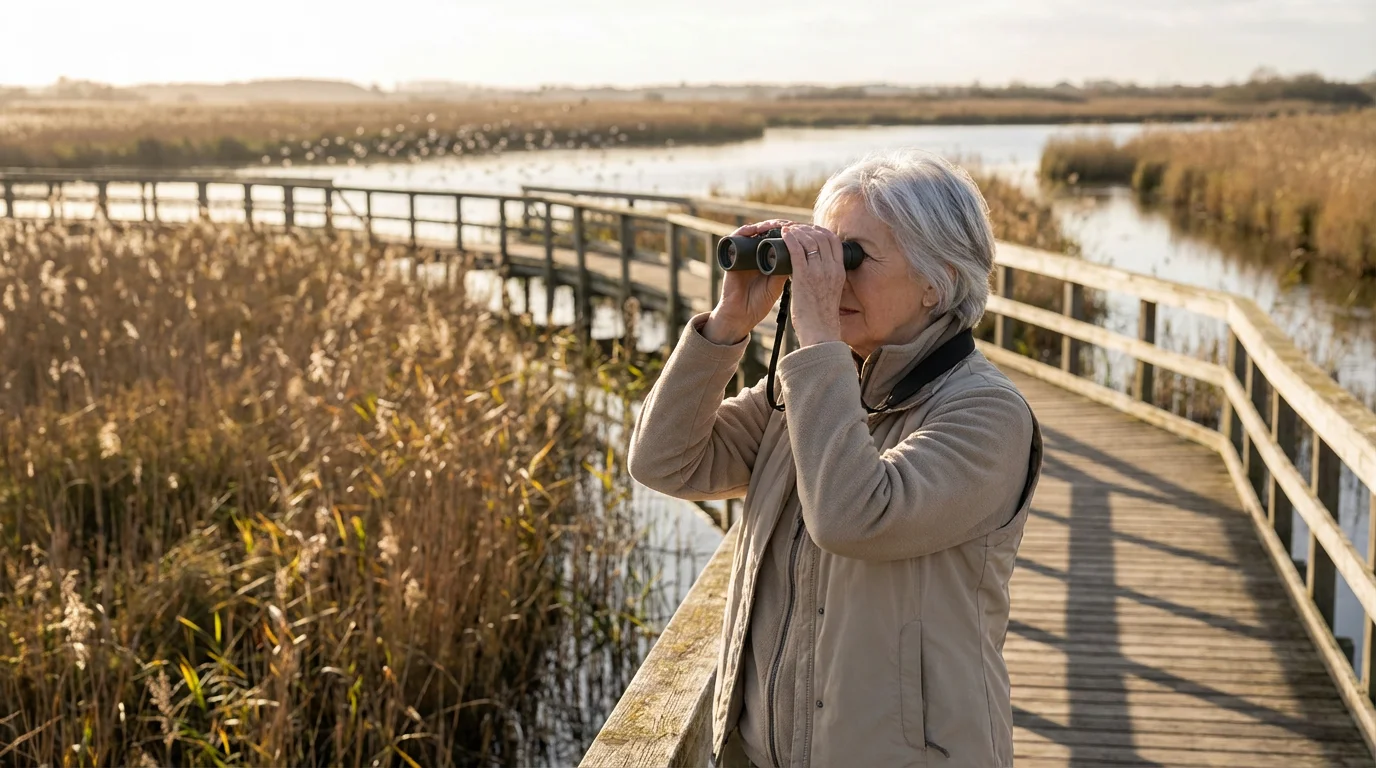
Check whether a site offers observation blinds with lower wheelchair-height viewing slots and firm, level approaches. Short boardwalk loops near wetlands often deliver the highest bird counts with the least elevation change.
National Wildlife Refuge Auto-Tour Loops and Entry Passes
Many U.S. Fish and Wildlife Service National Wildlife Refuges maintain one-way driving loops that turn your vehicle into a stationary blind. Waterfowl, hawks, and wading birds tolerate parked cars far longer than approaching walkers, letting you brace binoculars on a rolled-down window frame.
A clamp-style car-window mount or padded beanbag on the sill steadies heavier binoculars, spotting scopes, or lightweight wildlife camera kits without tiring your arms. Keep the engine off while watching so engine vibration does not blur the image.
When stepping out at overlooks, obey posted park buffers rather than walking closer for photos. Our guide to avoiding wildlife encounters outlines safe distance rules around large mammals.
An America the Beautiful Senior Pass (age 62+) or Access Pass covers entrance fees for the holder and non-commercial vehicle passengers at fee-charging National Wildlife Refuges, though separate timed-entry or special-use permit fees still apply.
Regional Field Guides and Local Audubon Walks
All-North-America field guides often weigh 2.5 pounds or more and crowd out-of-region lookalikes onto every page. A regional edition like David Sibley’s 464-page flexibound Field Guide to Birds of Eastern North America (2nd ed.) cuts weight and limits choices to your flyway.
Learn four visual clues before flipping pages: overall size, silhouette, bill shape, and feeding behavior. Backyard regulars such as sparrows, robins, and crows give you reliable size benchmarks whenever you spot an unfamiliar bird in the field.
Practicing beside experienced birders sharpens your eye faster than studying alone. Use the Audubon Near You directory to search local state offices, more than 450 community and campus chapters (507 total), and 55 centers and sanctuaries that host beginner bird walks.
Before joining a Saturday morning walk, ask the chapter coordinator about total distance, bench stops, and pavement versus dirt footing. Our guide to group hikes and outdoor outings outlines pacing habits that help every participant spot perched birds comfortably.
Test your binoculars on backyard feeders for a week before visiting a refuge, practicing the habit of spotting a bird with bare eyes first and raising the eyepieces without looking away. That simple motion locks species into view before they fly.