Planning an extended European cruise or rail tour past age 65 triggers paperwork traps that short trips avoid. Airlines and ports now enforce digital pre-clearances and strict passport clocks before departure.
On multi-country UK-and-Schengen trips, the real threat is rarely visa denial. Travelers get caught between Medigap’s 60-day foreign cutoff, Schengen’s 90-day clock, biometric kiosks, and airline battery rules.
Sequencing your $130 online passport renewal, £20 UK Electronic Travel Authorisation, travel insurance waiver window, and mobility-device approvals prevents denied boarding and uncovered hospital bills.
Passport Clocks for Extended Cruises, Rail Tours, and Ports
Many non-European countries and airlines enforce a six-month validity rule past your return date. Carriers deny boarding if your passport falls one day short.
Across the 29-country Schengen Area, European Union entry document rules enforce two strict dates. Your passport must be issued within the previous 10 years on arrival day and stay valid three months past departure.
Border officers reject passports issued over 10 years prior even when expiration dates remain months away. Closed-loop U.S. cruises accept a birth certificate and photo ID (16+) unless the cruise line requires a passport book.
Still, flying home from Canada or any foreign port in an emergency requires a passport book. Rail excursions crossing into Canada also require a passport book, passport card, Enhanced Driver’s License, or NEXUS card.

U.S. Passport Renewal Paths: Online Portal, Form DS-82, and Form DS-11
Adults 25 and older can renew online at opr.travel.state.gov via travel.state.gov instead of mailing Form DS-82. Routine online service requires applying six weeks before departure.
Online renewal covers undamaged 10-year passports expiring within one year or expired under five years, from a U.S. state or territory, without name or sex changes. Faster timelines require mail or in-person visits.
- Online renewal ($130): Use a MyTravelGov account at opr.travel.state.gov with a digital photo six or more weeks out.
- Expedited Form DS-82 ($190 to $216.87): Add $60 for two-to-three-week processing ($190) plus optional $26.87 one-to-three-day return delivery ($216.87).
- In-person Form DS-11: Apply at a post office or clerk for first adult books, lost or damaged books, or passports issued over 15 years ago.
- Blank pages: Confirm unstamped pages remain if non-Schengen ports require full-page visa stickers.
UK ETA, Schengen 90/180 Limits, and EES Biometric Kiosks
Britain and mainland Europe now tie visa-free entry to digital pre-clearance and biometric screening. Carriers verify approvals before issuing boarding passes.
U.S. citizens visiting the United Kingdom up to six months, or transiting landside through UK passport control, need a UK Electronic Travel Authorisation. Carriers began strict enforcement on February 25, 2026.
The UK ETA costs £20 as of April 8, 2026, covering Jersey, Guernsey, and the Isle of Man from April 9, 2026. Approved permits last two years or until passport expiration.
Across the 29 Schengen countries, including Portugal’s walkable Algarve coast, U.S. visitors get 90 visa-free days per rolling 180-day period. Every day inside the zone counts backward across the prior 180 days.
Since April 10, 2026, the EU Entry/Exit System (EES) has run at all external Schengen borders. Kiosks capture facial images, fingerprints, and digital entry-exit timestamps instead of passport stamps.
Biometric kiosks can stall travelers using wheelchairs, standing with difficulty, or scanning dry fingertips. Budget extra time at Eurostar terminals and cruise ports, and ask officers for staffed-booth help when kiosks fail.
The European Travel Information and Authorisation System (ETIAS) is not yet active, and no applications are open. EU timelines point toward 2027, when travelers over 70 will apply free of the €20 fee.
Skip sites selling ETIAS pre-registrations before the official EU portal launches. Confirm non-waiver e-visas or embassy visas on that country’s official embassy site.
Medigap Foreign Limits, Travel Insurance, and a Worked 75-Day Example
Original Medicare generally excludes care outside the United States. On cruise ships, Part B covers care only in U.S. ports or within six hours of one.
Medigap Plans C, D, F, G, M, and N cover 80% of billed foreign emergencies after a $250 annual deductible, up to a $50,000 lifetime cap. However, that benefit ends after day 60 of a trip.
Consider a 75-day spring trip spending 15 days in Britain and 60 days on slow Tuscany and European train routes, backed by $12,000 in non-refundable deposits. Although 60 days fits Schengen’s 90-day cap, Medigap coverage expires on day 60.
Days 61 through 75 rely on private policies, so buy comprehensive travel insurance for seniors early. Insurers typically apply a 60-to-180-day look-back unless you buy within 14 to 21 days of first deposit and insure 100% of prepaid non-refundable costs.
Per National Association of Insurance Commissioners guidance at naic.org, insurers set waiver days and must disclose exclusions upfront. Core documents for this 75-day trip cost $150 plus £20: $130 online passport, £20 UK ETA, and $20 in-person AAA driving permit.
Mobility-Device Border Paperwork, Batteries, and Medication Rules
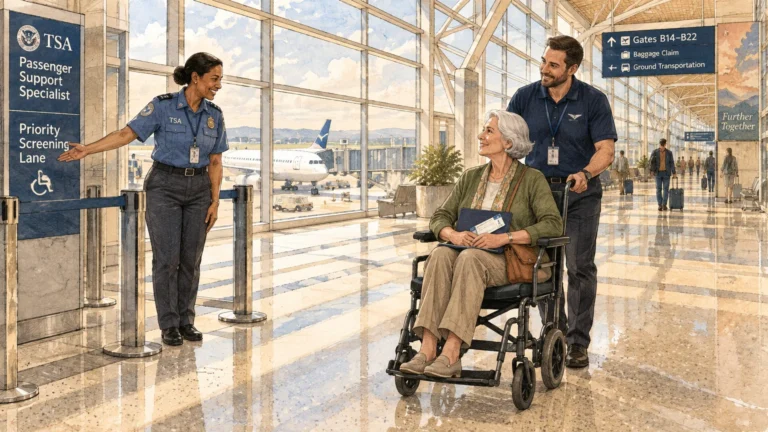
Flying to Europe with a CPAP machine, portable oxygen concentrator (POC), or powered wheelchair requires advance airline planning. Under the Air Carrier Access Act, airlines must provide free wheelchair assistance through terminals upon request.
Cabin-stowed CPAPs and POCs bypass carry-on counts when packed without personal items. Airlines control medical approvals and may require 48 hours’ notice plus a medical certificate for POCs.
Check lithium-ion battery ratings before packing, because FAA PackSafe rules cap watt-hours strictly.
- POC batteries: Units need an FAA compliance label, plus batteries covering 150% of maximum flight time (13.5 hours for a 9-hour crossing).
- Wheelchair batteries: Mobility-aid lithium-ion cells cap at 300 Wh installed when protected, plus one 300 Wh spare or two 160 Wh spares in carry-on.
- Power banks: Uninstalled lithium-ion spares go in carry-on only, up to 100 Wh freely or 101 to 160 Wh with airline approval (maximum two).
- TSA screening: Call TSA Cares at (855) 787-2227 at least 72 hours early; blunt-tipped poles fly in carry-on or checked bags, sharp tips checked only.
Domestic TSA checkpoints ended the shoes-off rule on July 8, 2025, though travelers 75 and older still remove light jackets outside TSA PreCheck. Declare medically necessary liquids to checkpoint officers.
Carry prescriptions inside original pharmacy-labeled bottles with a signed prescriber letter for controlled drugs. Ask your prescriber about time-zone dosing, check embassy bans early, and review this medication travel preparation guide.
International Driving Permits and Embassy Registration
For European car rentals, desks and police often reject a U.S. license alone. Only the American Automobile Association (AAA) and American Automobile Touring Alliance (AATA) issue valid U.S. International Driving Permits.
AAA charges $20 in person or $30 online ($20 plus $10 digital photo fee, excluding shipping) for a one-year permit. Carry it with your plastic U.S. license and skip overseas websites.
Enroll your itinerary in the State Department’s free Smart Traveler Enrollment Program (STEP) for embassy emergency alerts. Store offline phone scans and leave paper copies with family.
Pre-Departure Document and Coverage Timeline
Working backward protects waiver windows, passport timelines, and battery approvals.
| Timing | Required Action | Verified Cost or Limit | Decision Maker and Rule |
|---|---|---|---|
| 6–9 months out | Check issue/exit dates; renew online or DS-82/DS-11 | $130 online; $190–$216.87 expedited | State Dept. (6+ weeks routine); Schengen <10 yrs old + 3 mos past exit |
| 14–21 days from deposit | Buy comprehensive travel insurance | Insure 100% non-refundable costs; 60–180 day look-back | Insurer sets waiver; Medigap stops at day 60 / $50,000 |
| 3 months out | Apply for non-Schengen visas; check drug bans | Embassy fees vary; original pharmacy bottles | Destination embassy sets visas and drug bans |
| 4–6 weeks out | Get UK ETA and AAA or AATA IDP | £20 UK ETA; $20 in-person or $30 online AAA IDP | Carrier checks UK ETA; IDP valid 1 year |
| 48–72 hours out | Request airline POC/wheelchair clearance; call TSA Cares (855) 787-2227 | 150% POC batteries; 300 Wh wheelchair battery cap | Airline enforces FAA PackSafe; TSA clears checkpoints |
| 1 week out | Verify Schengen 90/180 count, STEP, and backups | Free STEP enrollment | Border officers enforce 90/180 at EES kiosks; passport book for emergency flights |
Four Paperwork Lapses That Trigger Denied Boarding or Uncovered Bills
Four lapses trigger most disruptions before older travelers reach customs.
- Missing the 14-to-21-day insurance waiver: Waiting until final payment forfeits pre-existing coverage and leaves days past day 60 exposed when Medigap foreign benefits stop.
- Using online passport renewal inside six weeks: Online service covers routine timelines only; rush trips require expedited Form DS-82 ($190 to $216.87) or urgent agency visits.
- Skipping the UK ETA or misreading issue dates: Landside London transfers require the £20 UK ETA, and Schengen borders reject passports issued over 10 years earlier.
- Lacking POC battery buffers or medical certificates: Carriers can deny boarding if POC batteries fall short of 150% flight time or lack 48-hour notice.