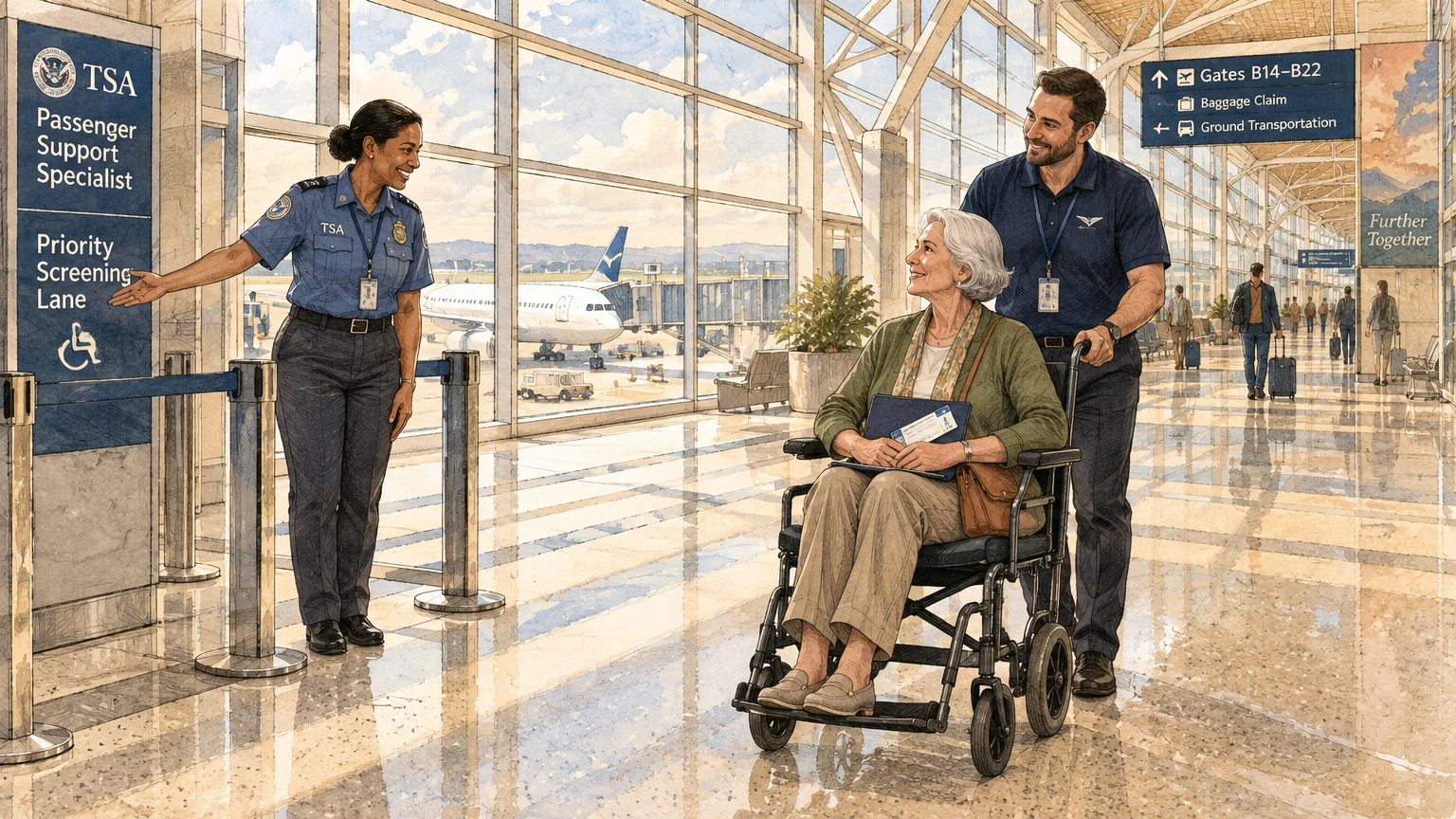
Airport wheelchair assistance and TSA Cares are two separate federal systems that require two separate bookings. Under the Air Carrier Access Act, airlines provide free wheelchairs and pushers from check-in to the gate, while TSA Cares covers only the security checkpoint.
For full gate-to-gate support, add the correct wheelchair code to your airline reservation at least 48 hours ahead and request a TSA Cares Passenger Support Specialist at least 72 hours before departure at (855) 787-2227.
How Airline Wheelchair Assistance and TSA Cares Split Responsibility
Federal rules in 14 CFR Part 382 Subpart G require airlines serving U.S. airports to provide prompt, free boarding, deplaning, preboarding, and connecting-gate wheelchair assistance. That mandate applies if you bring a personal mobility device or borrow an airport chair.
On August 4, 2026, the U.S. Department of Transportation issued a Notification of Enforcement Discretion pausing four provisions of its December 2024 wheelchair rule through April 30, 2027. Core Subpart G obligations for free gate-to-gate wheelchair assistance remain fully enforceable.
TSA Cares serves a narrower role inside the terminal. A TSA Passenger Support Specialist guides travelers with disabilities, medical conditions, or mobility devices through the screening lane, but TSA staff do not push airline wheelchairs or escort passengers to departure gates.
At busy hubs, your airline wheelchair attendant pushes you to the checkpoint entrance and transfers you to the screening officer or TSA Cares specialist. Once screening finishes, the airline attendant meets you on the sterile side and takes you to the gate.
Because airline attendants wait outside the screening lane rather than entering with you, your TSA specialist bridges only that short checkpoint gap. Coordinating both arrival times prevents long waits in a holding chair on either side of security.
Booking Airline Wheelchairs With IATA Codes WCHR, WCHS, and WCHC
Airlines match staffing and equipment using three standard IATA Special Service Request codes stored in your passenger record. Choosing the wrong code leaves you stranded at aircraft stairs or without an aisle chair when boarding begins.
| SSR Code | Walking Ability | Stair Climbing | Equipment Provided |
|---|---|---|---|
| WCHR | Needs wheelchair for long terminal distances | Can climb aircraft stairs unassisted | Standard airport wheelchair to gate or ramp |
| WCHS | Can walk slowly inside the cabin | Cannot climb aircraft stairs | Standard wheelchair plus stair lift or jet-bridge boarding |
| WCHC | Non-ambulatory; cannot walk in cabin | Cannot climb aircraft stairs | Standard wheelchair plus narrow aisle chair to aircraft seat |
Add your code inside your online reservation or by calling the airline accessibility desk. Delta Air Lines, for instance, accepts wheelchair requests in My Trips or at (404) 209-3434 (711 relay) and recommends at least 48 hours of advance notice.
If you travel with a personal wheelchair or scooter, record its weight, folded dimensions, and battery chemistry before calling. Giving the carrier exact measurements early ensures gate-check tags and cargo space are ready before you reach the airport.
Travelers planning multi-leg trips with scooters or mobility aids can review additional gear logistics in our guide to travel options for limited mobility.
Requesting a TSA Cares Passenger Support Specialist 72 Hours Ahead
Submit the online TSA Cares request form at least 72 hours before departure. If your flight leaves within 72 hours, skip the online form and call TSA Cares directly at (855) 787-2227 so a coordinator can log your checkpoint request.
If you miss both windows, ask a TSA podium officer for a Passenger Support Specialist upon arrival. Checkpoint waits vary with staffing, and disability status never grants TSA PreCheck access or a fee waiver without a Known Traveler Number on your boarding pass.
TSA Cares operates at U.S. airport checkpoints, so connecting flights that require re-clearing security need a separate checkpoint time listed on your request. Confirm whether your connection stays inside the secure concourse before submitting your form.
Have these five details ready before submitting your TSA Cares request:
- Departure and connecting airports, airline names, and exact flight numbers.
- The date and scheduled time you expect to reach the security checkpoint.
- Specific screening needs, such as a hip implant, pacemaker, ostomy bag, or inability to stand.
- Whether you travel with a personal wheelchair, walker, cane, or portable oxygen concentrator.
- A working mobile phone number so the airport coordinator can confirm your meeting point.
Joint Implants, Seated Screening, and Notification Cards at the Checkpoint
Travelers who cannot stand unassisted with arms raised in a body scanner can request seated screening or a pat-down inspection before entering the lane. Notify the podium officer early so staff route you directly to an alternate screening position.
Under TSA’s July 8, 2025 domestic policy update, shoes stay on unless an alarm triggers extra checks. Travelers 75 and older still remove light jackets for Advanced Imaging Technology scanners unless they hold TSA PreCheck on their boarding pass.
According to TSA guidance on disabilities and medical conditions, passengers with pacemakers or implanted defibrillators should alert the officer and avoid walk-through metal detectors. Metal joint replacements often trigger standard scanners, resulting in targeted hand-wand or pat-down verification over the surgical area.
Print and carry the free TSA Disability Notification Card from tsa.gov to hand discreetly to checkpoint officers. The card explains implants, prosthetics, or hidden medical devices without speaking aloud in line, though it never exempts anyone from required screening.
Medically necessary liquids, gels, and aerosols pass the checkpoint in reasonable quantities when declared to an officer for inspection. Confirm cabin exemptions, medical certificates, and battery rules for CPAP machines or portable oxygen concentrators directly with your airline 48 hours ahead.
See our medication travel guide for prescription packing, pharmacy labels, and temperature-control steps before you head to the airport.
Gate-to-Gate Handoff Schedule From Booking to Baggage Claim
Example: For a 10:30 a.m. departure with a 75-minute hub connection and a total knee replacement, pairing WCHR assistance with a timed TSA Cares request keeps both sides of the terminal handoff synchronized.
| Stage | Clock or Lead Time | Action and Responsible Party |
|---|---|---|
| At booking | 14+ days before departure | Add code WCHR to every flight segment online and confirm seat assignments near restrooms or bulkheads. |
| TSA Cares request | 72+ hours out | Submit the online TSA Cares form (or call (855) 787-2227 inside 72 hours) for an 8:30 a.m. checkpoint window. |
| Airline check-in | 48 hours out | Reconfirm the WCHR code with the airline accessibility desk and review connecting concourse maps in the carrier app. |
| Airport arrival | 8:30 a.m. (2 hours prior) | Request the airline chair at curbside or the ticket counter, then present your TSA Disability Notification Card at security. |
| Preboarding | 9:45 a.m. (45 min prior) | Board during preboarding, which airlines must offer before general boarding to passengers needing extra time. |
| Hub connection | 1:15 p.m. local | Stay seated until the aisle clears and the jet-bridge attendant arrives with your WCHR chair to reach the next gate. |
On a 75-minute connection, waiting 15 minutes to deplane leaves barely 20 minutes before the next door closes, so booking 90-minute minimum connections reduces missed-flight risk. Solo flyers can check additional arrival steps in our solo senior travel guide.
When the Wheelchair Is Late and How to File a DOT Complaint
Walking off the plane when a promised wheelchair is missing is a costly mistake. Leaving the aircraft unassisted signals to staff that you no longer need help, risking falls on long concourses and dropping you from the dispatch queue.
Stay seated and ask a flight attendant to verify that the gate agent received your SSR request before the cabin crew departs. If you have a tight connection, ask the crew to alert the connecting gate while the jet-bridge team dispatches your chair.
Under 14 CFR Part 382 Subpart G, the carrier operating your arriving flight must coordinate connecting wheelchair assistance, even if your next segment is on a partner airline. Never let staff leave you stranded without a confirmed handoff at the next gate.
If an airline fails to provide requested wheelchair assistance, misses a connection due to a late attendant, or damages your mobility device, document the failure before leaving the terminal. Note the flight number, date, wait duration, and names of gate agents you spoke with.
File a written complaint first with the airline’s disability assistance office so it enters the carrier’s record. Then submit an online disability complaint to the U.S. Department of Transportation’s Aviation Consumer Protection Division, which reviews Part 382 violations and tracks carrier compliance.